
AIDE(Weco AI):把 ML 工程建成代码方案树搜索的工程 Agent
📄 AIDE: AI-Driven Exploration in the Space of Code
2025-02 · Weco AI · 代码
一句话:Weco AI 的机器学习工程 agent——把「写代码→跑→改」建成一棵代码方案树(solution tree),用硬编码的树搜索策略系统性地起草、调试、改进解法;它是 OpenAI MLE-bench 上当之无愧的标杆 scaffolding。
📖 论文原文 Abstract(英文)
Machine learning, the foundation of modern artificial intelligence, has driven innovations that have fundamentally transformed the world. Yet, behind advancements lies a complex and often tedious process requiring labor and compute intensive iteration and experimentation. Engineers and scientists developing machine learning models spend much of their time on trial-and-error tasks instead of conceptualizing innovative solutions or research hypotheses. To address this challenge, we introduce AI-Driven Exploration (AIDE), a machine learning engineering agent powered by large language models (LLMs). AIDE frames machine learning engineering as a code optimization problem, and formulates trial-and-error as a tree search in the space of potential solutions. By strategically reusing and refining promising solutions, AIDE effectively trades computational resources for enhanced performance, achieving state-of-the-art results on multiple machine learning engineering benchmarks, including our Kaggle evaluations, OpenAI's MLE-Bench and METR's RE-Bench. The implementation of AIDE is publicly available at https://github.com/WecoAI/aideml.
相关:Agent Harness 总览 · 执行循环 · The AI Scientist · Agent Laboratory · AI Co-Scientist
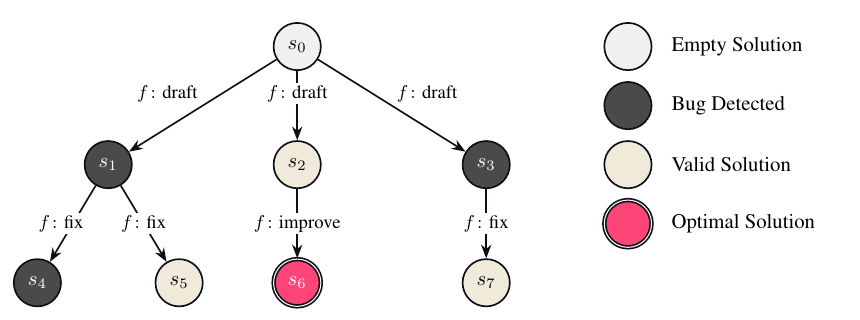
图源:Jiang et al., AIDE: AI-Driven Exploration in the Space of Code(arXiv:2502.13138)Figure 1——AIDE 的样例解法树,每个节点是一份 Python 脚本,箭头是 coding operator 提出的变换(用于学习注解,版权归原作者)。
动机与创新点:把 ML 工程从 ReAct 的「单调上下文累积」改成代码空间里的树搜索
机器学习工程(machine learning engineering)支撑了几乎所有现代 AI 成果,但它本质是个反复试错的苦活——"engineers and scientists developing machine learning models spend much of their time on trial-and-error tasks instead of conceptualizing innovative solutions"。传统 AutoML(贝叶斯优化、NAS、超参搜索)能自动化一部分,但它们在预定义的配置空间里搜索,需要大量领域专家先把搜索空间划好,且相对人类专家偏暴力、算力效率低、易过拟合验证集。
LLM 带来的新可能是:直接在代码空间里搜索,而不是在预定义配置里搜索(searching directly within the space of code rather than the space of predefined configurations),从而吃到 LLM 里海量的领域知识、把搜索收窄到更有前途的方向。但直接套 ReAct 式 agent 又有两个老问题——论文在 Preliminaries 里点得很直白:把任务建成 POMDP、"continually appending all historical data can lead to oversized prompts and limit scalability, because the model's context window eventually fills up";而且 POMDP 那套"lacks a principled way to break down the problem when there is a clear structure available"。
AIDE 的破题方式是换一个建模框架:不把 ML 工程看成一条长程决策轨迹,而看成一个无状态的优化问题——令
每个候选解
关键创新:
- 代码优化 + 树搜索的双重建模:把 ML 工程 reframe 为「在代码空间里求
」,把试错 reframe 为「在潜在解空间里做 tree search」,避开 ReAct 把全部历史塞进上下文的可扩展性瓶颈。 - 解法树(solution tree)+ 三类原子算子:所有历史解组织成一棵树,节点是脚本、边是改进尝试;coding operator 只有 draft / debug / improve 三个入口,每次 improve 只做"exactly one atomic change",让效果可直接归因。
- 硬编码搜索策略 π:用一条简单确定性规则(先铺多样初始解、再持续改进最优解、限制调试深度)决定下一步 draft/debug/improve,把"花算力的方向"集中到最有前途的节点。
- 摘要算子 Σ(T) 维持无状态视角:不追加全部日志,只抽取性能指标、超参设置、调试线索,"offers much of the benefit of incremental reasoning without exploding the prompt size"。
- 用算力换性能:树搜索"effectively trades computational resources for enhanced performance",在 Weco-Kaggle、MLE-bench、RE-bench 三套评测上拿到 SOTA 级结果(数字见「实验结果」)。
方法:解法树 + 硬编码搜索策略 + 三类 coding operator + 摘要算子
AIDE 的核心循环可以浓缩成 Algorithm 1:维护一棵解法树
形式化地,AIDE 由四个组件构成(论文 §3.1):一个解法树
解法树(solution tree):为什么是树而不是单线迭代
举例:根
派生出三个草稿 (draft),其中 、 跑出 bug(图中灰色), 是有效解(米色);对 连做两次 fix 得 ,对最有前途的 做一次 improve 得到当前最优解 (红色)。失败分支被记录但不再扩展,算力集中流向有前途的节点。
搜索策略 π:一条硬编码规则决定 draft / debug / improve
搜索策略
- Drafting——"if we have not yet reached the desired number of initial solutions":还没铺够多样的初始解时,先多 draft 几个不同起点;
- Debugging——"if a buggy node remains within a certain debug depth":有 buggy 节点且还在限定调试深度内,就修它;
- Improving——否则(otherwise),"typically targeting the best (non-buggy) solution":在当前最优有效解上继续改进。
这条策略落地了两条实用启发式:(1) 先探索一组多样的初始解、并持续改进其中最优者;(2) 对一个坏解限制调试尝试次数——避免在一个修不好的分支上无限耗算力。
Coding operator f:draft / debug / improve 三个专用入口
coding operator 有三个主入口,各配一套专用 prompt:
- Drafting——需要从零造一个全新解时触发。它"prompts an LLM to outline a brief plan for a model(e.g., specifying a particular network architecture or feature-engineering idea),then emits a single-file Python program implementing that plan"——先让 LLM 列个简短方案(选哪种网络架构、什么特征工程思路),再吐出一份单文件 Python 程序实现它。
- Debugging——专修 buggy 解。"By inspecting error logs and execution traces, it attempts to rectify issues like broken imports, incorrect tensor dimensions, or other coding errors while preserving the overall approach"——读报错日志和执行轨迹,修 import 错、张量维度错等编码问题,且保留整体方法不变。
- Improving——已有一个有效非 buggy 解、但还能从数据预处理/架构/优化上改进时触发。关键约束是每次只动一处:LLM "proposes exactly one 'atomic' change, such as switching optimizers or adding a regularization technique, so that its effect on performance is directly measurable"——只做一个原子改动(换优化器、加正则等),让它对性能的影响可被直接度量。
举例:improve 一次只把 Adam 换成 AdamW、或只加一层 dropout,而不是同时改五个地方——这样若分数变好/变差,能干净地归因到这一个改动上,避免「一次改一堆、说不清谁起了作用」。
论文强调:把这三类操作组合起来,"keeps the solution tree structured and ensures that each new node arises from a well-defined modification of a parent node"——每个新节点都来自对父节点的一次定义明确的修改,树因此始终结构清晰。
摘要算子 Σ(T) 与 Data Preview:维持「无状态」又不爆上下文
尽管能生成任意多的解,AIDE 不把全部历史日志塞进 prompt,而是用上下文摘要算子
- 性能指标(accuracy、AUC-ROC、test set loss 等);
- 超参设置(若某解涉及超参扫描);
- 调试相关线索(如 traceback 里维度对不齐的数组形状)。
设计动机正是前面那条无状态原则——"each code revision stands on its own, but
此外,ML 版 AIDE 还在每个 prompt 里塞一小段静态 Data Preview——把数据集元数据(行数、列名、数据划分)写进 workspace 再插入 coding operator 的 prompt,"giving the LLM basic knowledge of dataset size or feature layouts"。它不是完整 EDA,但这点轻量信息能帮 AIDE 做关键代码决策(怎么切验证集、怎么缩放超参),而无需反复把庞大的数据集上下文塞进去。
实验结果:Weco-Kaggle / MLE-bench / RE-bench 三线 SOTA 级
评测设置:Weco-Kaggle 与 leaderboard-quantile 口径
AIDE 自建了 Weco-Kaggle 基准——63 个不同复杂度和数据规模的 Kaggle 竞赛,覆盖表格、图像分类、时序预测;从中取 16 个偏低复杂度、主要靠 CPU 的表格任务做 Weco-Kaggle Lite。评测协议的关键是用 leaderboard quantile:定义 Exceeds % of Human
Benchmark 表现(以原文为准)
Weco-Kaggle Lite(16 个表格任务,对比基线):AIDE 用 GPT-4 Turbo 取得 Exceeds % of humans 51.38、Above Median 50.00,平均超过约一半 Kaggle 参与者、在半数任务上高于人类中位数;显著优于传统 H2O AutoML 与 LangChain AutoGPT,也优于「人类用 ChatGPT 辅助」。逐竞赛看,AIDE 的 Exceeds % of Human 从最难任务的约 13% 到最易任务的近 92% 不等。
| Agent | Model | Exceeds % of humans ↑ | Above Median (%) ↑ |
|---|---|---|---|
| AIDE | GPT-4 Turbo | 51.38 | 50.00 |
| Human with ChatGPT | GPT-4 Turbo | 41.17 | 18.75 |
| AutoML (H2O) | N/A | 35.34 | 18.75 |
| AutoGPT (LangChain) | GPT-4 Turbo | 32.34 | 0.00 |
在完整 Weco-Kaggle(63 个竞赛)上,平均 Exceeds % of Humans 为 48.23%,在 49.21% 的竞赛中超过人类中位数——在部分任务上接近顶尖水平,但表现随数据集/任务差异较大。
MLE-bench(OpenAI,75 个真实 Kaggle 竞赛,pass@1):AIDE 是搭配 SOTA 模型时表现最好的 agent 框架——论文指出 MLAB 的 ResearchAgent、OpenHands 等"tended to terminate early or struggle with iterative refinement",而 AIDE 的优化中心式设计带来更高的有效提交率,最终拿更多奖牌。其中 AIDE + o1-preview 在 16.9% 的竞赛里拿到奖牌,约为后继 agent OpenHands 的近 4 倍。
| Agent | Model | Valid Subm. (%) | Above Median (%) | Gold (%) | Any Medal (%) |
|---|---|---|---|---|---|
| AIDE | o1-preview | 82.8 ± 1.1 | 29.4 ± 1.3 | 9.4 ± 0.8 | 16.9 ± 1.1 |
| AIDE | GPT-4o | 54.9 ± 1.0 | 14.4 ± 0.7 | 5.0 ± 0.4 | 8.7 ± 0.5 |
| AIDE | Claude 3.5 | 51.1 ± 3.3 | 12.9 ± 2.2 | 4.4 ± 1.4 | 7.6 ± 1.8 |
| AIDE | Llama 3.1 | 27.3 ± 2.6 | 6.7 ± 1.4 | 1.7 ± 0.7 | 3.0 ± 1.0 |
| OpenHands | GPT-4o | 52.0 ± 3.3 | 7.1 ± 1.7 | 2.7 ± 1.1 | 4.4 ± 1.4 |
| MLAB | GPT-4o | 44.3 ± 2.6 | 1.9 ± 0.7 | 0.8 ± 0.5 | 0.8 ± 0.5 |
同一个底层模型,加不加 AIDE scaffolding 差距巨大——这正是 Agent Harness 的核心命题。在 MLE-bench Lite(低复杂度子集)上,o1-preview 套上 AIDE 后:有效提交率 63.6%→92.4%、超过人类中位数 13.6%→59.1%、金牌率 6.1%→21.2%(翻三倍多)、任意奖牌率 7.6%→36.4%(近五倍),且各项
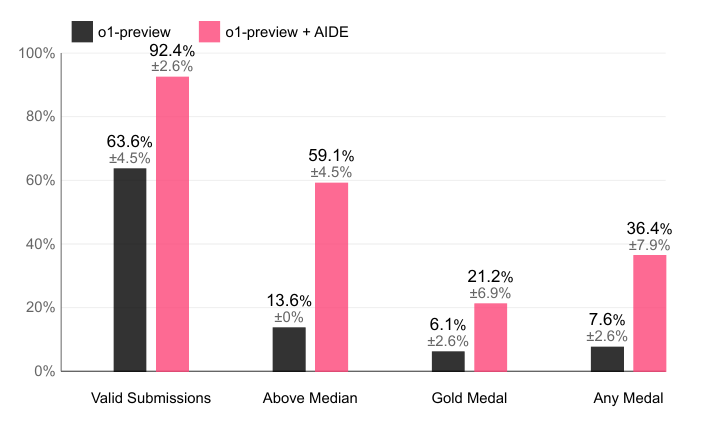
图源:Jiang et al., AIDE: AI-Driven Exploration in the Space of Code(arXiv:2502.13138)Figure 3——o1-preview 在 MLE-bench Lite(complexity=low)上有无 AIDE 的性能对比(用于学习注解,版权归原作者)。
RE-bench(METR,7 个 AI 研发任务):METR 把更难的 AI R&D 任务(从优化 Triton Kernel 到用 GPT-2 做 QA 微调)建成优化任务后套 AIDE 评测。AIDE 因 LLM 能更快实现方案、跑更多迭代,在 6 小时内一度超过顶尖人类科学家;尤其在 Optimize a Kernel 上,它发现一个定制 Triton 方案,比九位人类专家在 64 小时内做到的都快。但随后人类追了上来——AIDE 的简单贪心策略容易陷入局部最优,在需要处理大代码库、或单次改进涉及多步交互的环境(如 Agent for Rust CodeContests)里,它倾向"repeating local patches instead of discovering new strategies"。这是它最务实的能力边界。
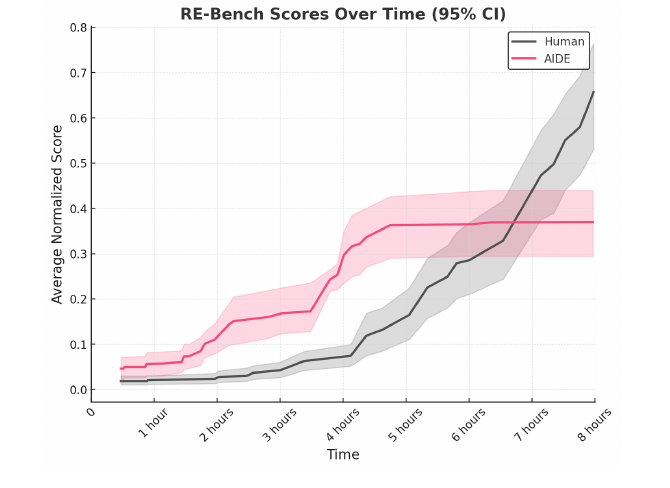
图源:Jiang et al., AIDE: AI-Driven Exploration in the Space of Code(arXiv:2502.13138)Figure 4——AIDE+o1-preview 与顶尖人类科学家在 7 个 AI R&D 任务上的平均得分随时间变化(用于学习注解,版权归原作者)。
看榜须知:这些分数的口径、时点、底座模型、test-time 设置、test-set 划分各异,且论文明确警示**预训练污染(pre-training contamination)**风险——许多 Kaggle 竞赛解法可能已在训练语料里,绝对值跨系统直接比意义有限;当作「同期 ML 工程 scaffolding 能力的量级参照」即可。
在 Agent Harness 谱系里的位置
- vs The AI Scientist / Agent Laboratory:后两者是端到端科研 agent(选题→实验→写论文),AIDE 是其中「实验 / ML 工程」那一段的专精版与标杆——这一档目标有客观 ground truth(榜单名次、验证集分数),进展能被干净量化,不像「论文质量」那样难评判。代价是能力边界更窄:AIDE 只把已知指标做高,不提出新科学问题、不写论文。AI Scientist-v2 的 agentic tree search 与 AIDE 的解法树同源,可对照阅读。
- vs ReAct 类通用 agent:AIDE 的整个设计就是冲着 ReAct「把全部历史观测追加进上下文、当成单一巨型优化问题」的可扩展性瓶颈去的——它用解法树显式拆解问题、用
控上下文,把"何时该退回到哪个节点"变成结构化决策而非靠长上下文硬记。 - vs 传统 AutoML(H2O / Auto-Sklearn / NAS):AutoML 在预定义配置空间里搜(需专家先划好空间、偏暴力),AIDE 在代码空间里搜、吃 LLM 的领域知识来收窄方向;实验里 AIDE 也直接压过了 H2O AutoML 基线。
- vs DS-Agent / AutoML-Agent:DS-Agent(ICML'24)用案例推理(CBR)从 Kaggle 经验迁移做数据科学,AIDE 靠树搜索在代码空间探索,路线不同;AutoML-Agent 是覆盖「数据检索→可部署模型」全流程的多 agent 框架、面更宽,AIDE 更聚焦竞赛/benchmark 式的指标优化。
- vs MLE-bench / MLAgentBench / RE-bench:这些是「考卷」(评测环境)而非 agent,AIDE 是在它们上被对比、且常居榜首的「考生」之一——也正因如此,它成了衡量「scaffolding 给同一模型带来多大增益」的事实标准底座。整体定位见 Agent Harness 总览。